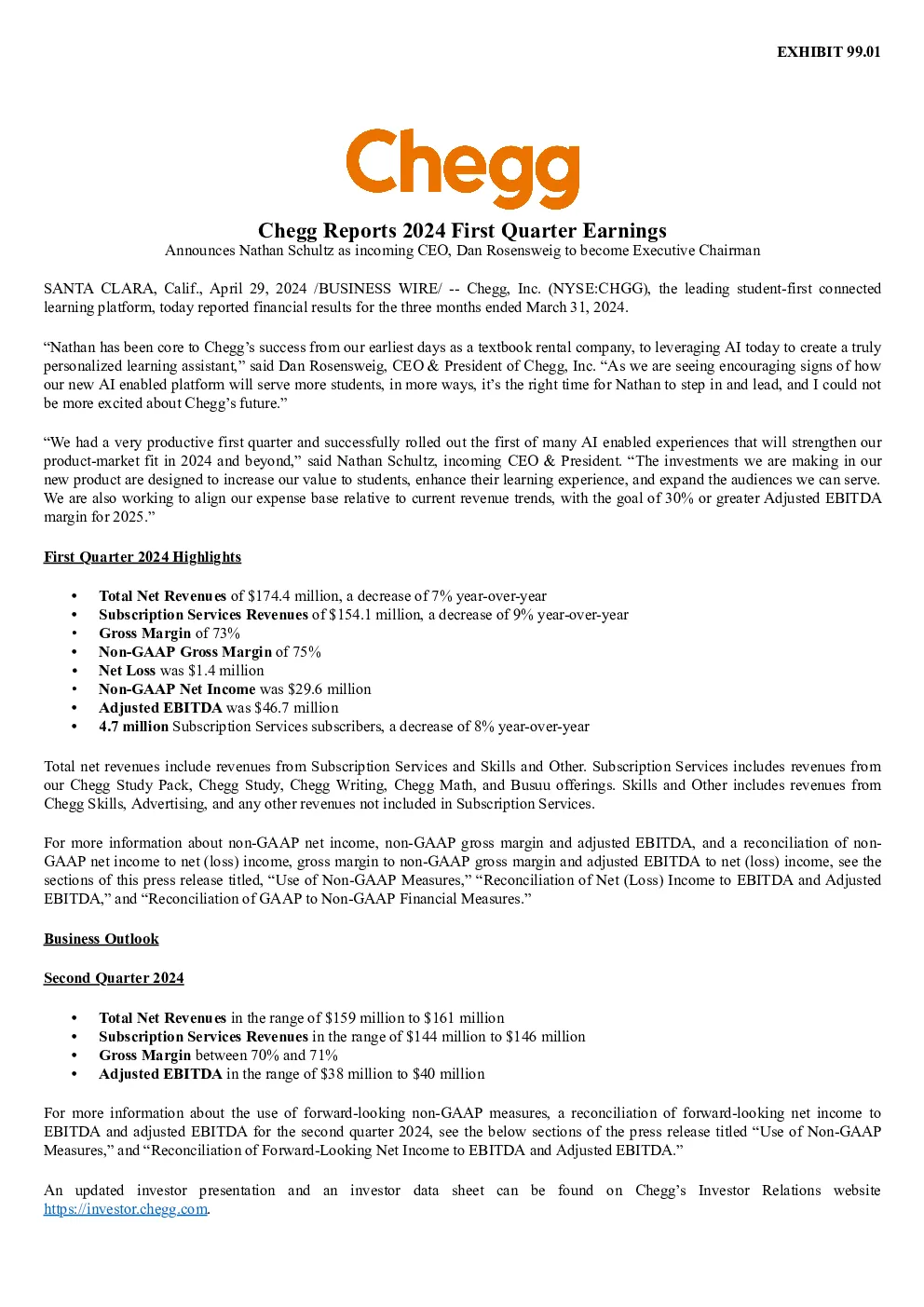
Chegg, Inc., a leading student-focused connected learning platform, announced Nathan Schultz as its incoming CEO, with current CEO Dan Rosensweig transitioning to Executive Chairman. This change is set to take effect on June 1st. The announcement comes after a successful first quarter where Chegg reported total net revenues of $174.4 million, a decrease of 7% year-over-year. Subscription Services revenues dropped by 9% to $154.1 million, while the Gross Margin stood at 73%, and Non-GAAP Gross Margin reached 75%. Despite a net loss of $1.4 million, Chegg saw a Non-GAAP Net Income of $29.6 million and an Adjusted EBITDA of $46.7 million. The company currently has 4.7 million Subscription Services subscribers, down 8% from the previous year.
In the second quarter of 2024, Chegg projects total net revenues to fall within the range of $159 million to $161 million, with Subscription Services revenues estimated to be between $144 million to $146 million. The Gross Margin is expected to be between 70% and 71%, and Adjusted EBITDA is forecasted to lie within the range of $38 million to $40 million.
Nathan Schultz emphasized Chegg's focus on AI-enabled experiences that aim to strengthen the product-market fit in 2024 and beyond. He highlighted Chegg's investments in new products designed to increase student value, enhance learning experiences, and expand audiences served. The company is also working to align its expense base relative to current revenue trends, targeting a goal of achieving a 30% or greater Adjusted EBITDA margin for 2025.
Dan Rosensweig expressed his excitement about Chegg's future under Nathan's leadership, noting Nathan's pivotal role in Chegg's development since its early days as a textbook rental company. He also discussed Nathan's contributions to Chegg's leadership team by adding new roles such as Chief Marketing Officer, SVP of Business Operations, and Chief Product Officer.
Chegg anticipates a transformative moment with the proliferation of AI, emphasizing its ability to uniquely harness this potential in education. The company has embraced AI and has rebuilt its user experience and services, launching a multi-year product-led growth plan to emerge from the post-COVID period and return to revenue and profit growth.
Nathan Schultz further elaborated on Chegg's AI-enabled platform, which includes proprietary AI technology and large language models specifically verticalized for education. He mentioned that Chegg aims to own these large language models and quality assurance layers, enabling the company to control quality and accuracy at a lower cost compared to generic AI platforms.
Chegg is focusing on rolling out enhancements and features that deliver a richer personalized learning experience, including real-time conversational support, generating flashcards, practice problems, and focused study guides. These efforts are aimed at increasing the value to students and expanding the audiences Chegg can serve in a cost-efficient manner.
Looking ahead, Nathan expressed excitement about Chegg's future under his leadership, highlighting the company's unique assets and its potential to deliver the most effective learning experience possible.