处处拐点
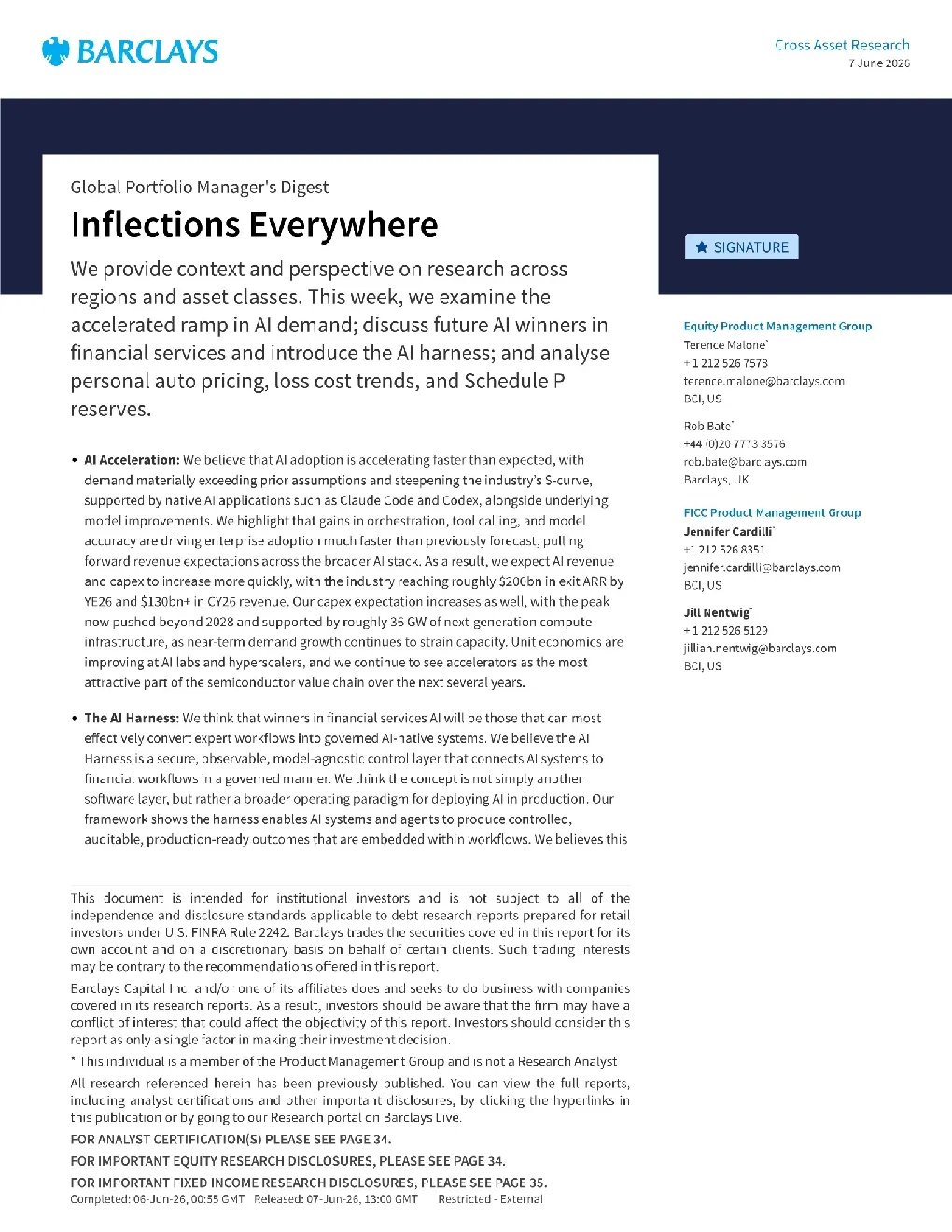
Inflections Everywhere We provide context and perspective on research acrossregions and asset classes. This week, we examine theacceleratedrampinAldemand;discussfutureAlwinnersinfinancialservicesandintroducetheAlharness;andanalysepersonal auto pricing, loss cost trends, and Schedule Preserves. Terence Malone +1212 526 7578terence.malone@barclays.comBCI, USRob Bate' +44 (0)20 7773 3576rob.bate@barclays.comBarclays, UK demand materially exceeding prior assumptions and steepening the industry's S-curve,supported by native Al applications such as Claude Code and Codex, alongside underlyingmodel improvements. We highlight that gains in orchestration, tool calling, and modelaccuracy are driving enterprise adoption muchfaster than previously forecast,pullingforward revenue expectations across the broader Al stack. As a result, we expect Al revenueand capex to increase more quickly, with the industry reaching roughly $2oobn in exit ARR byYE26 and $130bn+ in CY26 revenue.Our capex expectation increases as well,with the peakinfrastructure,as near-term demand growth continues to strain capacity.Unit economics areimproving at Al labs and hyperscalers, and we continue to see accelerators as the mostattractive part of the semiconductor value chain over the next several years. JenniferCardilli+12125268351jennifer.cardilli@barclays.comBCI, US Jill Nentwig'+12125265129jllian.nentwig@barclays.comBCI, US .The Al Harness: We think that winners in financial services Al will be those that can mosteffectively convert expert workflows intogoverned Al-native systems.Webelieve the AlHarness is a secure, observable, model-agnostic control layerthat connects Al systems tofinancial workflows in a governed manner.We think the concept is not simply anothersoftware layer,but rather a broader operating paradigm for deploying Al in production. Ourframework showsthe harness enables Al systems andagents toproducecontrolled,auditable,production-ready outcomes that are embedded within workflows.We believes this This document is intended for institutional investors and is not subject to all of theindependence and disclosure standards applicable to debt researchreports preparedfor retailinvestors under U.S. FINRA Rule 2242. Barclays trades the securities covered in this report for itsown account and on a discretionary basis on behalf of certain clients. Such trading interestsmay be contrary to the recommendations offered in this report. Barclays Capital Inc. and/or one of its affiliates does and seeks to do business with companiescovered in its research reports. As a result, investors should be aware that the firm may have aconflict of interest that could affect the objectivity of this report. Investors should consider thisreport as onlya single factorin making their investment decision. * This individual is a member of the Product Management Group and is not a Research Analyst All research referenced herein has been previously published. You can view the full reports,including analyst certifications and other important disclosures,by clicking the hyperlinks inthis publication or by going to our Research portal on Barclays Live. FOR ANALYST CERTIFICATION(S) PLEASE SEE PAGE 34.FORIMPORTANTEQUITYRESEARCHDISCLOSURES,PLEASESEEPAGE34.FORIMPORTANTFIXED INCOMERESEARCHDISCLOSURES,PLEASESEEPAGE35.Completed: 06-Jun-26, 00:55 GMT Released: 07-Jun-26,13:00 GMTRestricted -External lag in the nextphaseof Aladoption. reassess loss cost trends, pricing dynamics, and reserve adequacy to inform our updatedmargin outlook.Recent company commentary and data points suggest a more challengingbackdrop; as a result, we recalibrate our attritional loss ratio assumptions, driving up our lossratio outlook for 2027 and reducing our EPS estimates. That said, carriers retain meaningfulcapacity for favorable prior-year development throughout 2026, although we expect a muchmore muted favorable release profile in 2027 as price vs.loss cost spreads keepwidening tothe downside. Investorfocus has also shifted toward the long-term implications ofautonomous vehicleadoption andthepotentialeffecton thetotaladdressablemarket. Al's S-Curve Is Steepening Ross SandlerBCl,US|AlexHughes BCI,US|MichaelDiSantoBCl,US|Owen Clendenin BCI,U Alexander Kessinger BCI, US|Tom O'Malley BCI, US|Kyle Bleustein BCI, US U.S. Internet PositiveU.S.Semiconductors&SemiconductorCapitalEquipmentNeutral 2026 leadinglabscouldgenerateover $130B inrevenuethisyear,with exitARRnear$200B,whichisrunningayearahead ofourpreviousforecasts. native Al applications like Claude Code and Codex, coupled with underlying modelimprovements.Advancements in orchestration,toolcalling,and the underlyingmodelaccuracyrevenue estimates forward across the entire Al ecosystem,fromall the majorlabs to manycompanies across the application layer. Asa result, we expect bothrevenue and Al capextocommentary from thelargest Al hyperscalers, with Google noting that capex will ramp"significantly" again in 2027.Backlogs are star