Revolution Medicines:ASCO会议后我们更加确信
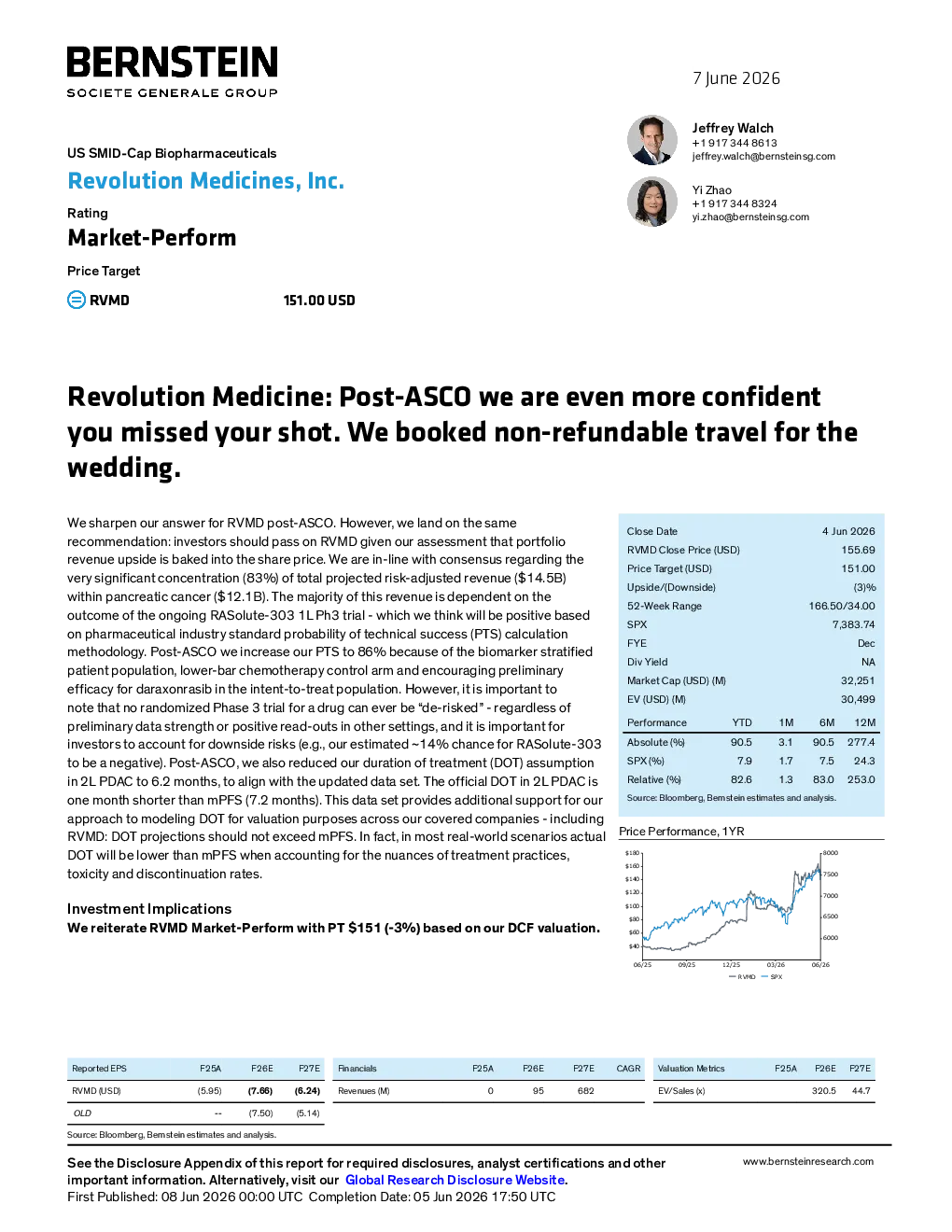
Price Target Revolution Medicine: Post-ASCO we are even more confidentyou missed your shot. We booked non-refundable travel for thewedding. We sharpen our answer for RVMD post-ASCO. However, we land on the samerecommendation: investors should pass on RVMD given our assessment that portfoliorevenue upside is baked into the share price. We are in-line with consensus regarding thevery significant concentration (83%) of total projected risk-adjusted revenue ($14.5B)within pancreatic cancer ($12.1B). The majority of this revenue is dependent on theoutcome of the ongoing RASolute-303 1L Ph3 trial - which we think will be positive basedon pharmaceutical industry standard probability of technical success (PTS) calculationmethodology. Post-ASCO we increase our PTS to 86% because of the biomarker stratifiedpatient population, lower-bar chemotherapy control arm and encouraging preliminaryefficacy for daraxonrasib in the intent-to-treat population. However, it is important tonote that no randomized Phase 3 trial for a drug can ever be “de-risked” - regardless ofpreliminary data strength or positive read-outs in other settings, and it is important forinvestors to account for downside risks (e.g., our estimated ~14% chance for RASolute-303to be a negative). Post-ASCO, we also reduced our duration of treatment (DOT) assumptionin 2L PDAC to 6.2 months, to align with the updated data set. The official DOT in 2L PDAC isone month shorter than mPFS (7.2 months). This data set provides additional support for ourapproach to modeling DOT for valuation purposes across our covered companies - includingRVMD: DOT projections should not exceed mPFS. In fact, in most real-world scenarios actualDOT will be lower than mPFS when accounting for the nuances of treatment practices,toxicity and discontinuation rates. Investment Implications We reiterate RVMD Market-Perform with PT $151 (-3%) based on our DCF valuation. DETAILS Key messages: 1. Daraxonrasib looks like a winner in pancreatic cancer: We are bullish on the outlook for patients2. The market put a ring on RVMD last year: If RASolute-303 doesn't hit then the wedding will be called off3. Where do we go from here? Non-KRAS G12C mutations is a good place to start Company summary. Revolution Medicines, Inc. is a late-stage clinical oncology company focused on the development of precision therapies formalignancies driven by oncogenic RAS mutations, which constitute one of the most prevalent and clinically significant drivers ofhuman cancer. Revolution Medicines is advancing late-stage clinical development of RAS(ON) inhibitors that selectively targetthe active, GTP-bound conformation of RAS proteins, a signaling state directly implicated in oncogenic pathway activation andhas historically presented significant challenges for small-molecule drug discovery. Pipeline overview and key upcoming catalysts. Exhibit 1 summarizes the late-stage and early clinical development pipeline of Revolution Medicines, with a portfolio ofRAS(ON)–selective inhibitors across multiple oncogenic RAS indications and settings. Daraxonrasib is a multi-selective RAS(ON) inhibitor and represents the most advanced candidate of the RVMD pipeline, withmultiple Phase 3 RASolute studies across pancreatic ductal adenocarcinoma (PDAC) and non–small cell lung cancer (NSCLC). In PDAC, daraxonrasib is being evaluated in several clinical settings: 1.RASolute-302 (NCT06625320),a Phase 3 study in 2L mPDAC comparing oral daraxonrasib against investigator’s choicechemotherapy, which is going to report its pivotal results in 1H26, likely during ASCO conference. 2.RASolute-303 (NCT07491445),a Ph3 trial evaluating daraxonrasib in combination with gemcitabine plus nab-paclitaxel(GnP) vs standard-of-care chemotherapy in 1L mPDAC, which started treating patients in March 2026 (PR LINK), with aprimary completion estimated in June 2028 3.RASolute-304 (NCT07252232), a Phase 3 adjuvant study in resected PDAC, where daraxonrasib is compared withstandard-of-care observation, with disease-free survival (DFS) as the primary endpoint, and is anticipated to be primarilycompleted in May 2029. In NSCLC,RASolve-301 (NCT06881784)assesses daraxonrasib as monotherapy in 2/3L metastatic NSCLC, with PFS andOS as co-primary endpoints. The company is also planning to initiate the Ph3 study in 1L metastatic NSCLC setting, with detailsfor the combination strategy to be announced. Collectively, these studies evaluate daraxonrasib across early and late diseasesettings, as both monotherapy and in combination, supporting its role as a backbone RAS(ON) inhibitor. Zoldonrasib is a KRAS G12D–selective RAS(ON) inhibitor being developed in both monotherapy and combination regimens,with a particular emphasis on PDAC. Early Phase 1 studies (e.g., RMC-9805-001) are enrolling patients with advanced solidtumors to evaluate zoldonrasib alone or in combination with daraxonrasib. Building on this, the pipeline includes Phase 3RASolute studies in PDAC, inclu