货币政策向家庭信贷的传导:来自乌干达信贷登记数据的证据(英)
 AI智能总结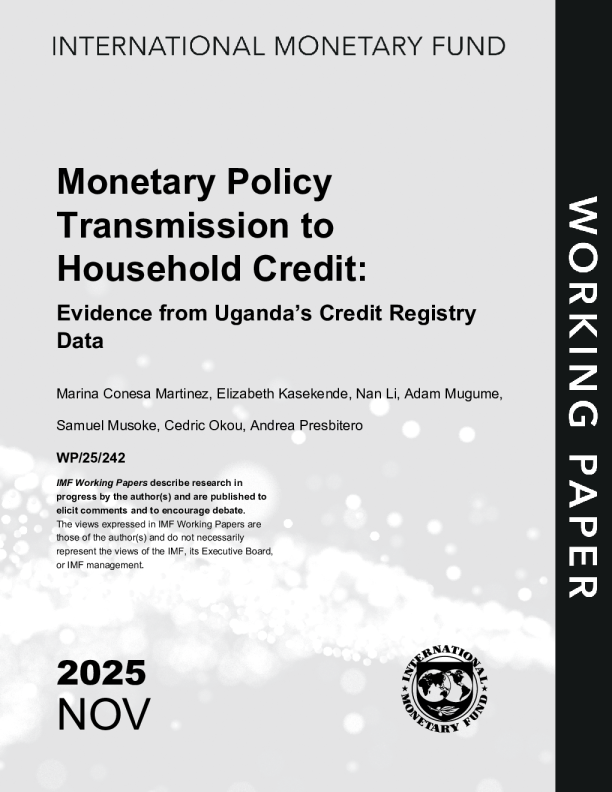
Monetary PolicyTransmission to Evidence from Uganda’s Credit Registry Marina Conesa Martinez, Elizabeth Kasekende, Nan Li, Adam Mugume, Samuel Musoke, Cedric Okou, Andrea Presbitero WP/25/242 IMF Working Papersdescribe research inprogress by the author(s) and are published toelicit comments and to encourage debate.The views expressed in IMF Working Papers are IMF Working PaperResearch Department Monetary Policy Transmission to Household Credit: Evidence from Uganda’s Credit Registry DataPrepared by Marina Conesa Martinez, Elizabeth Kasekende, Nan Li, Adam Mugume, Authorized for distribution by Petia Topalova IMF Working Papersdescribe research in progress by the author(s) and are published to elicitcomments and to encourage debate.The views expressed in IMF Working Papers are those of the ABSTRACT:This paper examines the effectiveness of monetary policy transmission in developing countriesusing loan-level data from Uganda’s credit registry. We analyze more than 632,000 household loans issued byall commercial banks between 2017 and 2023, a period marked by significant policy rate fluctuations. We findthat household credit, which accounts for over 50 percent of new loan accounts, responds to monetary policy: WORKING PAPERS Monetary Policy Transmission to Evidence from Uganda’s Credit Registry Data Prepared by Marina Conesa Martinez, Elizabeth Kasekende, Nan Li, AdamMugume, Samuel Musoke, Cedric Okou, and Andrea Presbitero.1 1Introduction The effectiveness of monetary policy transmission remains a central concern in policy debates indeveloping countries. Unlike in advanced economies, structural constraints—such as fiscal dom-inance, shallow financial markets, and limited institutional credibility—have historically weak-ened the transmission, leading to continued reliance on direct credit, moral suasion, and price controls (Frankel, 2010; Mishraet al., 2012; Mishra and Montiel, 2013; Berg and Portillo, 2018). Empirical evidence on the strength of the monetary transmission mechanism in LICs has beenmixed.Studies relying on aggregate macro data, which cannot fully disentangle demand and supply factors, often find a weak or insignificant transmission (Mishra and Montiel, 2013; Mishraet al., 2014). In contrast, recent work using supervisory loan-level data has revealed more promis- This paper builds on Abukaet al.(2019) and expands the existing literature by investigating how monetary policy shocks are transmitted to thehouseholdsector—a sector that has receivedlittle attention in the literature. Yet, household credit is a significant and growing share of totalprivate credit, accounting for about 25 percent of total bank lending in Uganda, with a rising trend in both volume and number of accounts. Indeed, over 50 percent of new loan accounts are issued to households. In LICs, household borrowing plays a crucial role not only in supporting privateconsumption and housing investment—both key drivers of inflation and aggregate demand—but We employ loan-level data from Uganda’s credit registry to analyze how the terms of newhousehold loans respond to changes in monetary policy and macroeconomic conditions, with aparticular focus on how these effects vary across banks with different balance sheet characteristics— Our rich dataset from Uganda’s Credit Reference Bureaus (CRBs) provides the universe of ad-ministrative records on new household loans issued by all commercial banks and credit institutions— representing virtually all household lending in the economy. For each loan, the CRBs collect in-formation on loan terms (volume, interest rate, fixed vs floating rate, and maturity), loan propose,borrower location, and basic demographic characteristics (such as gender and employment sta- A key empirical challenge in applying the methodology of Khwaja and Mian (2008)—whichdecompose credit variation into time-varying bank and borrower-time fixed effects—is the re-quirement that borrowers engage with multiple banks, which is rarely the case in developingcountries. In Uganda, for example, over 99 percent of household borrowers are served by a sin-gle commercial bank. To address this limitation, we adopt the methodology proposed by Abuka Before examining the bank lending channel, we first establish the basic pass-through of mone-tary policy to household credit. We find that monetary policy transmission to household credit inUganda operates with considerable lags and varies across loan characteristics. A 100 basis point Our main analysis implements time-varying synthetic borrower fixed effect to cleanly identifycredit supply effects and examine how bank balance sheet characteristics shape the transmissionmechanism. In addition to studying the conventional indicators of balance sheet strength—bankcapital and liquidity ratios—we investigate the implications of the sovereign-bank nexus. Com-mercial banks in developing countries typically hold disproportionately large shares of their as- Our analysis yiel