塑造农业的深度技术革命(英)
 AI智能总结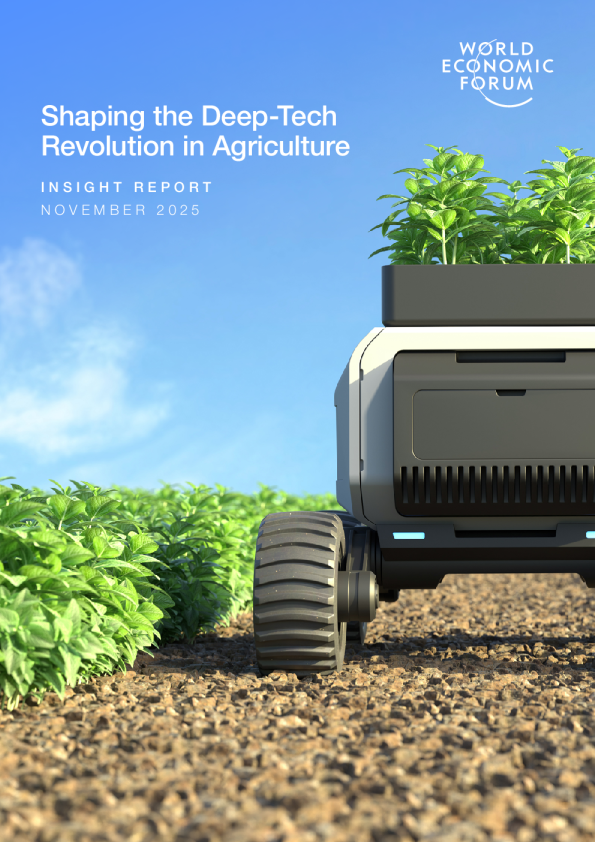
I N S I G H TR E P O R T Contents Foreword Executive summary4 Introduction5 3 A detailed look at promising agri deep-tech domains 3.2 Computer vision12 3.3 Edge internet of things (edge IoT)14 3.4 Satellite-enabled remote sensing16 3.5 Robotics (including drones)18 3.6 CRISPR20 3.7 Nanotechnology22 4 Tech convergences and breakthrough use cases for agriculture24 4.1 Breakthrough use cases26 Conclusion Annexe: Selecting technology domains for detailedexamination – methodology Contributors Endnotes Disclaimer This document is published by theWorld Economic Forum as a contributionto a project, insight area or interaction.The findings, interpretations andconclusions expressed herein are a resultof a collaborative process facilitated andendorsed by the World Economic Forumbut whose results do not necessarilyrepresent the views of the World Economic Foreword Jeremy Jurgens Managing Director,Centre for the Fourth Ranveer ChandraChief Technology Officer, Globally, agriculture stands at a defining momentin history. As the world faces the intersectingpressures of climate change, resource degradation,demographic shifts and geopolitical instability, theability to sustainably feed a growing population isunder increasing strain. Conventional approaches, patient capital, robust digital infrastructure andskilled human capital. Collaboration acrossgovernments, research institutions, start-ups,corporations and financiers will be essential In a bid to demystify the potential of deep tech inagriculture, the World Economic Forum’s ArtificialIntelligence for Agriculture Innovation (AI4AI)initiative with support from partners globally hasdeveloped this insight report. It highlights themost pressing challenges facing agriculture and Deep tech, spanning domains such as artificialintelligence (AI), robotics, biotechnology,nanotechnology and satellite-enabled systems,offers several opportunities to reshape food andfarming systems. These technologies not onlylead to incremental improvements but can trigger The report also outlines actionable pathways toaccelerate the adoption of deep tech in agriculture.Consequently, it is an invitation to policy-makers,corporations, innovators, academia, research andfunders to recognize the pivotal role of deep tech Seeding and commercializing deep-techinnovations, however, requires deliberate ecosystem Executive summary Deep tech has the potential to future-proofagricultural systems, but collaboration is The agricultural sector globally faces convergingpressures: a shrinking workforce, intensifyingclimate extremes, natural resource degradation,rising food demand and geopolitical instability.These challenges threaten food security and rural Satellite-enabled remote sensing:Allows continuous and large-scale affordable costs, aiding data-driven decision-making. Enhanced spatial and spectral capabilitiesand increased data capture frequency are drivingadoption in agriculture, although the level of This report explores deep tech’s potential inagriculture and identifies seven promising deep-techdomains as pivotal for tackling current and future Robotics:Permits the automation oflabour-intensive tasks such as precision Advances in AI-enabled perception and cloud-edgeintegration are driving its adoption. However, highcapital costs limit its uptake in low-wage, labour- Generative AI (GenAI):Offers use-casesranging from tailored farmer advisory andpest management to agentic AI systems CRISPR:Accelerates the developmentof crops with enhanced traits such as and climate risk simulations. GenAI’s applicabilityin agriculture is driven by recent advances inlarge language models (LLMs) and the increasingavailability of agricultural data. However, despitethese advances and the growing adoption of GenAI, bypassing lengthy traditional breeding cycles. Thepotential precision and speed of CRISPR-basedediting are significant drivers of use, but regulatory Computer vision:Provides usecases such as rapid pest and disease Nanotechnology:Offers precision innutrient and pesticide delivery, reducing The growth of computer vision use cases hasbeen fuelled by decreasing camera costs andadvances in deep-learning models. However, unlikein industrial units, on-field variability (for instance, enables a wide range of use cases, ranging frompest and nutrient management to controlled releaseof inputs to biosensing, though a lack of research This report identifies breakthrough agri deep-techuse cases derived from these domains. As severalare yet to be commercialized, it further providesrecommendations to optimize support for agri deeptech. It elaborates collaborative efforts in policy,finance, human capital, data/digital infrastructure Edge internet of things (IoT):Enablesreal-time, on-farm data processing agriculture. This minimizes latency and bandwidthdependency, especially in areas with poor internetconnectivity. Edge IoT can improve decisionsrelated to irrigation, fertilization and dis