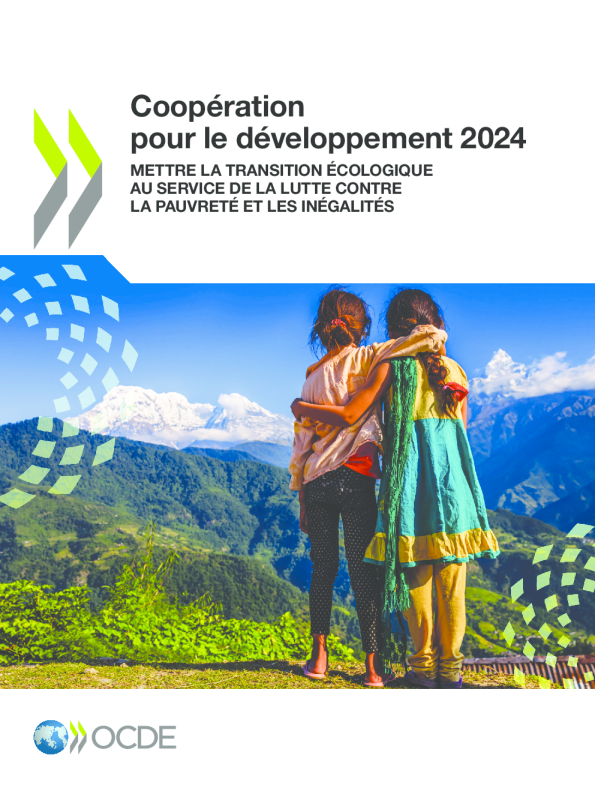
2024年发展合作报告:通过绿色转型解决贫困和不平等问题
 AI智能总结
Development Co‑operationReport2024TACKLING POVERTY AND INEQUALITIES THROUGHTHE GREEN TRANSITION This work is published under the responsibility of the Secretary-General of the OECD. The opinions expressed andarguments employed herein do not necessarily reflect the official views of the Member countries of the OECD.This document, as well as any data and map included herein, are without prejudice to the status of or sovereignty overany territory, to the delimitation of international frontiers and boundaries and to the name of any territory, city or area.The statistical data for Israel are supplied by and under the responsibility of the relevant Israeli authorities. The use ofsuch data by the OECD is without prejudice to the status of the Golan Heights, East Jerusalem and Israeli settlements inthe West Bank under the terms of international law.Note by the Republic of TürkiyeThe information in this document with reference to “Cyprus” relates to the southern part of the Island. There is no singleauthority representing both Turkish and Greek Cypriot people on the Island. Türkiye recognises the Turkish Republic ofNorthern Cyprus (TRNC). Until a lasting and equitable solution is found within the context of the United Nations, Türkiyeshall preserve its position concerning the “Cyprus issue”.Note by all the European Union Member States of the OECD and the European UnionThe Republic of Cyprus is recognised by all members of the United Nations with the exception of Türkiye. Theinformation in this document relates to the area under the effective control of the Government of the Republic of Cyprus.Please cite this publication as:OECD (2024),Development Co-operation Report 2024: Tackling Poverty and Inequalities through the Green Transition, OECDPublishing, Paris, https://doi.org/10.1787/357b63f7-en.ISBN 978-92-64-52960-1 (print)ISBN 978-92-64-54839-8 (PDF)ISBN 978-92-64-42433-3 (HTML)ISBN 978-92-64-39943-3 (epub)Development Co-operation ReportISSN 2074-773X (print)ISSN 2074-7721 (online)Revised version, November 2024Details of revisions available at: https://www.oecd.org/en/publications/support/corrigenda.htmlPhoto credits:Cover © hadynyah/Getty Images.Corrigenda to OECD publications may be found at: https://www.oecd.org/en/publications/support/corrigenda.html.© OECD 2024Attribution 4.0 International (CC BY 4.0)This work is made available under the Creative Commons Attribution 4.0 International licence. By using this work, you accept to be bound by the terms of this licence(https://creativecommons.org/licenses/by/4.0/).Attribution– you must cite the work.Translations– you must cite the original work, identify changes to the original and add the following text:In the event of any discrepancy between the original work and thetranslation, only the text of original work should be considered valid.Adaptations– you must cite the original work and add the following text:This is an adaptation of an original work by the OECD. The opinions expressed and arguments employed inthis adaptation should not be reported as representing the official views of the OECD or of its Member countries.Third-party material– the licence does not apply to third-party material in the work. If using such material, you are responsible for obtaining permission from the third party and forany claims of infringement.You must not use the OECD logo, visual identity or cover image without express permission or suggest the OECD endorses your use of the work.Any dispute arising under this licence shall be settled by arbitration in accordance with the Permanent Court of Arbitration (PCA) Arbitration Rules 2012. The seat of arbitration shallbe Paris (France). The number of arbitrators shall be one. DEVELOPMENT CO-OPERATION REPORT 2024 © OECD 2024PrefaceTheproportion of the global population living in extreme poverty declined after the SustainableDevelopment Goals were launched,from10.8%or 787 million people in 2015,to8.4%or 689 millionpeoplein 2019.The COVID-19 pandemic was a setback for further progress, and based on the currenttrajectory, 7.0% of the world population, nearly 575 million people, will still be living in extreme poverty in2030. In parallel, the impacts of climate change will disproportionately fall on the most vulnerable, andthreaten to push an additional 132 million people into extreme poverty.Development assistance, as a stable and reliable source of financing for developing countries, has a keyrole to play, in accelerating progress in poverty reduction and development, supporting climate adaptation,and leveraging the green transition to support resilient, sustainable and inclusive growth.Both Official Development Assistance (ODA) and climate finance for developing countries have reachedrecord levels despite significant pressure on public budgets. Preliminary figures show that total ODAreachedUSD223.7billionin 2023, setting a record for the fourth consecutive year. Climate finance fromofficial bilateral and multilateralsources reached USD115.9